[ Kataloge ][ Biographie ][ Werke][Nicht realisierte Projekte/Kunst-am-Bau][ Arbeiten auf Papier ][ Bibliographie ][ Werkliste Videos ][ Kontakt ][ Interviews ][ Impressum ] ][Home]
[ Kataloge ][ Biographie ][ Werke][Nicht realisierte Projekte/Kunst-am-Bau][ Arbeiten auf Papier ][ Bibliographie ][ Werkliste Videos ][ Kontakt ][ Interviews ][ Impressum ] ][Home] |
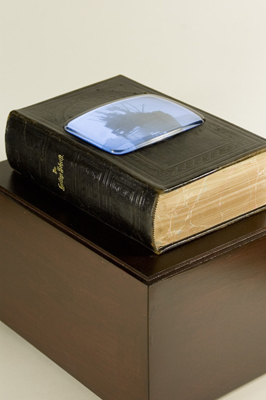
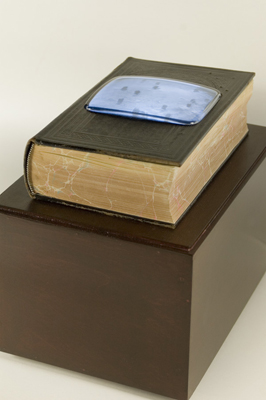
Uomo sacro, 2011 *
Videoobjekt, Mixed Media, Mini-TV-Bildröhre (schwarz-weiß) ohne Gehäuse, Buch: Die heilige Schrift, Holzsockel lackiert, Mediaplayer, Videoloop (Found footage) 1 Min., 22 Sek.
Maße: 24 x 20,7 x 28,6 cm (mit Sockel)"Am Anfang war der Logos." Im Prolog des Johannesevangeliums bezeichnet der Logos weit mehr als das Wort. Er ist das Prinzip, durch das die Welt ins Dasein tritt. Sprache, Vernunft und Schöpfung fallen in einem Ursprung zusammen, der über den Glauben hinaus zum Fundament der abendländischen Kultur geworden ist. Wenn der Logos die Welt hervorbringt, bleibt er zugleich mit der Verantwortung verbunden, ihr in der Geschichte Sinn zu geben.
Uomo sacro entsteht aus der Begegnung dieses Ursprungs mit einem historischen Ereignis.
Auf dem Einband einer Bibel zeigt ein kleiner Monitor in einer Endlosschleife die Ankunft der Vlora im Hafen von Bari am 8. August 1991. Tausende Menschen fliehen nach dem Fall der Berliner Mauer aus Albanien über die Adria nach Italien. Dieses Bild ist längst Teil des kollektiven Gedächtnisses geworden. Zugleich markiert es den Beginn einer neuen geschichtlichen Konstellation: das Ende der bipolaren Weltordnung, die wachsende Verflechtung der Märkte, die grenzüberschreitende Bewegung des Kapitals - und mit ihr die Bewegung der Menschen. Die Geschichte öffnet die Zeit des Exodus von Neuem.
Der Exodus gehört zu den Gründungsmythen der Bibel. Er erinnert nicht nur an eine vergangene Befreiung, sondern bezeugt, dass das Leben niemals aufhört, seine Freiheit zu suchen. Wo Menschen Armut, Unterdrückung oder Gewalt hinter sich lassen, kehrt der Exodus als geschichtliche Wirklichkeit zurück.
Deshalb tritt das Bild der Vlora in die Bibel ein.
Nicht um ihren Inhalt zu illustrieren.
Sondern um ihn zu befragen.
Die Arbeit stellt Bild und Wort nicht gegeneinander. Das historische Ereignis dringt in das Buch ein und ruft den Logos an seinen Ursprung zurück. Wenn das Wort die Welt hervorbringt, kann es der Welt nicht fremd bleiben, die es weiterhin hervorbringt. Die Wirklichkeit bestätigt die Schrift nicht und widerlegt sie auch nicht.
Sie zwingt sie, lebendig zu werden.
Der Titel verweist auf Giorgio Agambens Homo sacer: das schutzlos dem Recht entzogene Leben. Dieser Bezug bildet einen Ausgangspunkt, erschöpft jedoch nicht den Sinn der Arbeit. Uomo sacro entwickelt keine Theorie der Biopolitik, sondern befragt das Verhältnis zwischen dem schöpferischen Wort und der Geschichte als kontingente Realität - zwischen dem, was der Welt Gestalt geben will, und einer Welt, die jede Gestalt immer wieder überschreitet.
Das dokumentarische Bild tritt nicht als Fremdkörper in die Bibel ein. Es durchdringt sie, ohne sie zu entweihen. Der Bibeltext bleibt unversehrt, doch seine Bedeutung verändert sich. Das Wort verliert seine Autorität nicht; es wird wiederbelebt, um sich der Fleischlichkeit der Geschichte zu stellen.
"Und das Wort wurde Fleisch."
Vielleicht gewinnt dieser Satz gerade hier seine radikalste Bedeutung zurück. Die Wahrheit des Logos besteht nicht im transzendenten Verharren über der Welt, sondern darin, immer dann Fleisch zu werden, wenn die Geschichte ihn anruft. Das Bild der Vlora unterbricht den Logos nicht.
Es gibt ihn seine Verantwortung zurück.
ENGLISH
SACRED MAN (2011)
"In the beginning was the Logos." In the Prologue to the Gospel of John, the Logos is more than the Word. It is the principle through which the world comes into being. Language, reason and creation converge in an origin that reaches beyond faith to shape the foundations of Western culture. If the Logos brings the world into existence, it also bears the responsibility of giving meaning to history.
Sacred Man emerges from the encounter between this origin and a historical event.
Embedded in the cover of a Bible, a small monitor continuously plays footage of the Vlora arriving in the Italian port of Bari on 8 August 1991. Thousands of men and women fleeing Albania reached the Italian coast in the aftermath of the fall of the Berlin Wall. That image has entered Europe's collective memory, yet it also marks the beginning of a new historical condition: the end of the bipolar world, the growing interdependence of economies, the circulation of capital across borders and, with it, the movement of human lives. History reopens the time of the Exodus.
The Exodus is one of the founding narratives of the Bible. It is not simply the memory of a liberation accomplished long ago, but the affirmation that life never ceases to seek freedom. Whenever human beings set out to escape poverty, oppression or violence, the Exodus returns as a living force within history.
This is why the image of the Vlora enters the Bible.
Not to illustrate its message.
But to question it.
The work does not oppose image and word. Rather, it is the historical event that enters the Book, calling the Logos back to its own origin. If the Word generates the world, it cannot remain detached from the world it continues to generate. Reality neither confirms nor refutes Scripture.
It compels it to live.
The title recalls Giorgio Agamben's Homo Sacer: life exposed to abandonment, deprived of the protection of law. This is a point of departure rather than a conclusion. Sacred Man is not a theory of biopolitics. It is an inquiry into the relationship between the founding word and history, between what claims to give form to the world and the world that constantly exceeds every form.
The documentary image does not enter the Bible as a foreign body. It passes through it without profaning it. The Book remains intact, yet its meaning is transformed. The Word does not lose its authority; it is called upon to confront the flesh of history.
"And the Word became flesh."
Perhaps it is here that this sentence recovers its most radical meaning. The truth of the Logos does not lie in remaining above the world, but in becoming flesh whenever history calls upon it. The image of the Vlora does not interrupt the Logos.
It restores it to its responsibility.