[videoclip 158 KB][Artikel][ Kataloge ][ Biographie ][ Werke][ Arbeiten auf Papier ][ Bibliographie ][ Werkliste Videos ] [ Kontakt ][ Interwiews ][ Impressum ] ][Home]
[videoclip 158 KB][Artikel][ Kataloge ][ Biographie ][ Werke][ Arbeiten auf Papier ][ Bibliographie ][ Werkliste Videos ] [ Kontakt ][ Interwiews ][ Impressum ] ][Home] |
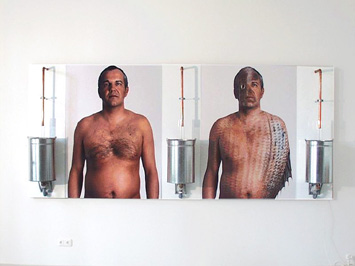
"Zeit 1 - Zeit 2", 2000
Installation, 136 x 320 x 40 cmZeit 1 - Zeit 2, 2000
In dieser Arbeit geht es um die Frage einer noch möglichen Strategie der Umwälzung, nicht in dem Sinne, was Menschen machen, sondern was mit Ihnen geschieht. Es ist die Frage der Opposition zwischen der biopolitischen Identität und der Biomacht (wie man es in Anlehnung an Jack Lacan, Michel Foucault, Antonio Negri nennt). Eine Frage der Entwicklung im kapitalistischen und technologischen Zeitalter.
Entwickelt sich der Mensch, indem er sich - symbolisch gesehen - in einen Fisch verwandelt, zurück zu sich selbst, zu den wesentlichen kulturellen und zivilisatorischen Bedürfnissen? Gelingt es ihm, zum Ursprung zurück zu gelangen, dorthin, woher er kommt: zum Wasser, zum Anfang der Evolution/Revolution? Oder wandelt sich der Mensch zum Monstrum, zur kafkaesken Paranoia und Schreckensvision? Wer setzt sich durch, das Biopolitische, die Moltitude oder die Biomacht? Das Hybride oder das Manichäistische?
Installation, 136 x 320 x 40 cm(english)
Time 1 Tim 2, 2000
Photo-Installation (Two digital color Photographs, 3 zinc buckets, electric pumps, light barrier)
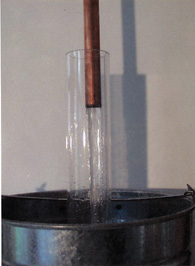
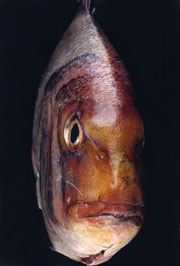
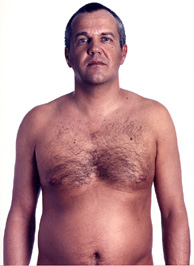
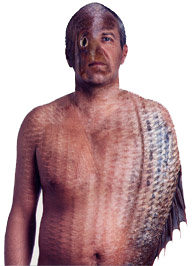
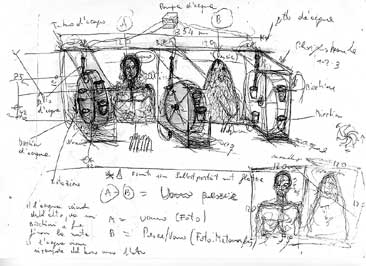
55" x 128" x 16"The work "Time 1 - Time 2" is composed of two photographs, each about 1 m x 1.36 m. The photo on the left side portrays a man of approximately 40 years of age. The second photograph is a picture of the same man who is nearly transformed into a fish. The transformation is brutal and hard, the eye of the fish seems to almost emerge from the human skull. Between the two photographs and on the left and right side of the photos, three buckets are placed, filled with water that runs through a closed system of tubes and pumps. The water flows continuously from the tube placed on each bucket (as if it were a tap). The flow of water is prompted by a sensor that reacts to the viewer's presence.
The photographic technique was based on a traditional, chemically developed picture which was then manipulated digitally through computer processing. "Time 1- Time 2" is a work that reflects a post-natural human context. In such a context, bio-genetic operations permit a new type of discourse. Issues concerning both human nature and ethics may now be explored directly by studying DNA structures. The delicate and complex process of Darwin's evolution is thus superceded. The evolution of mankind and of res extensa (of nature), becomes one arbitrary operation, dependent on res cogitas (mankind itself): Evolution becomes a syllogism. The figure of the man and the symbolic one of man/fish is an expression of this syllogism. The question is posed if DNA manipulation makes qualitative evolution possible. That is evolution in terms of both the ethical world (including res cogitas) and the world of nature (res extensa).
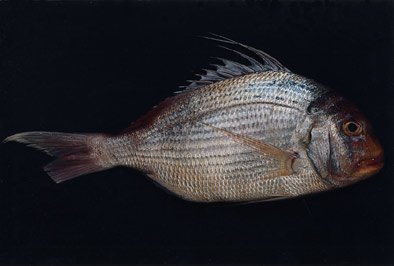
In the work "Time 1 - Time 2 " the picture of a "fish/man " has a double reference: On the one hand it symbolizes monstrosity and absurdity, on the other hand, catharsis and existence.
Costantino Ciervo, 2002
(Italian)
Tempo 1 - tempo 2, 2000Installazione (due fotografie elaborate digitalmente, 3 secchi di zinco, pompe elettriche, sensore), 136x320x40
Il lavoro è composto da due fotografia ognuna di 1 m x 1,36 m. La fotografia a sinistra mostra un uomo di circa 40 anni. La seconda fotografia mostra lo stesso uomo che si è quasi trasformato in un pesce. Il passaggio è brutale e duro, l'occhio del pesce sembra quasi emergere dal teschio umano. Tra le due fotografie e ai due lati estremi sono posti tre secchi d'acqua che attraverso un sistema chiuso di tubi e pompe vengono riforniti continuamente da un getto d'acqua fuoriuscente dal tubo di rame posto sul secchio stesso (come se fosse un rubinetto).
L'azione dell'acqua viene innescata da un sensore che interagisce con lo spettatore. La tecnica fotografica usata parte da una matrice ottenuta da uno sviluppo chimico tradizionale per poi essere stata rielaborata digitalmente al computer.
Tempo 1- Tempo 2 é un lavoro che riflette un contesto umano post-naturale nella quale attraverso operazioni biogenetiche è possibile mettere in discussione la natura e l'apparato umanistico etico intervenendo direttamente nella struttura del DNA. Il processo delicato e complesso dell'evoluzione darwiniana viene incalzato. L'evoluzione dell`uomo e della res extensa, (della natura), diventa una operazione arbitraria dipendente dalla pura res cogitas (che è ancora l'uomo stesso): L'evoluzione diventa un sillogismo.
La figura a dell'uomo e quella simbolica dell'uomo/pesce prende atto di questo sillogismo e ne domanda se è possibile attraverso la manipolazione del DNA ottenere una evoluzione qualitativa riferita al mondo etico (che include la res cogitas) e al mondo della natura (la res exensa).
Nell'opera la matrice "pesce/uomo" è un doppio riferimento, da una parte alla mostruosità e l'assurdità, dall'altra alla catarsi, essenzialità.
Costantino Ciervo, 2002